Oolong brand
Language: English | 简体中文
Status: brand foundation and naming guide. This document records what the name means, how Oolong describes itself, and where brand language must stop. The architecture remains the source of truth for technical contracts.
1. Brand core
Oolong is calm infrastructure for interfaces through which output keeps arriving.
Its central promise is:
Streams can be long. The live interface stays bounded.
Completed output moves forward into terminal-owned history. Only work that is open, changing, or deliberately interactive remains live. The brand should make that motion feel natural without turning the implementation into a metaphor.
Oolong should feel:
- flowing, because data arrives incrementally;
- bounded, because session age does not become live UI cost;
- quiet, because an idle interface does no work and writes no bytes;
- warm, because it is made for people using terminals, not for a rendering demo;
- precise, because ownership, ordering, failure, and dependency direction are explicit;
- composable, because applications assemble behavior instead of entering a closed framework.
2. The name
2.1 Official spelling
The product name is Oolong in prose and oolong in repository names, module paths, commands, and wordmarks that use lowercase.
ooloog is not an alternate spelling. Its repeated circles have visual energy, but it looks like a typo, loses the real-word association, and makes pronunciation, search, and recall harder. A wordmark may make the letters flow into one another, but the n must remain recognizably an n.
2.2 A left-to-right flow
The lowercase word has a useful visual reading:
oo                 l                    o                    ng
upstream flow -> processing boundary -> bounded live view -> terminal and history- The first
oosuggests successive chunks arriving from upstream. - The vertical
lsuggests a narrow processing and ownership boundary. - The following
osuggests the one bounded, still-live presentation. - The final
ngcarries the word onward toward the terminal surface; the descender ofgmay suggest output continuing below the viewport into scrollback.
This is a visual story, not an acronym and not a technical state machine. It should guide a wordmark or a small motion study without being forced into every explanation of the project.
2.3 oo + long
The word also reads naturally as oo plus long: a flow may be long-running without making the active interface grow for just as long. This is the strongest connection between the name and the streaming-first architecture.
The claim is architectural, not decorative. Oolong earns it only while committed payload leaves the component graph, incremental transforms retain short open tails, and work is bounded by the live interface rather than session age.
2.4 The tea association
Oolong tea gives the name warmth and memorability. Water passes through leaves and draws out content over time, which is a gentle secondary image for incremental transformation. It is not the primary technical explanation, and it must not become a taxonomy for the codebase.
3. Positioning
3.1 Official descriptor
Use this complete technical descriptor:
Oolong is a streaming-first terminal UI substrate for Go.
Use this shorter form where space is limited:
Streaming-first terminal UI for Go.
The word substrate is intentional. Oolong supplies terminal, publication, interaction, layout, text, headless behavior, and polished component foundations. It does not require every application to adopt one product grammar or one declarative authoring model.
3.2 Message order
When introducing Oolong, explain it in this order:
- Output can keep arriving incrementally.
- Finished output becomes terminal scrollback instead of permanent live UI state.
- One goroutine owns ordinary mutable domain objects.
- Headless behavior and polished appearance compose in separate layers.
- Lower packages remain general and dependencies point one way.
Do not lead with a widget catalogue, a comparison to another framework, or an internal rendering technique. Those are consequences and implementation choices. The lifetime of output is the differentiator.
3.3 Claims and their proof
| brand claim | technical truth required |
|---|---|
| streaming-first | incremental ingestion and transformation; explicit ordering, batching, backpressure, cancellation, and finalization |
| bounded | committed payload and per-item placement leave the live graph; memory and resize cost do not follow session age |
| terminal-native | completed output is published into scrollback and is not retained merely so the program can redraw it |
| composable | headless behavior, polished kit components, and product grammar remain distinct and depend one way |
| Go-native | concrete domain objects, consumer-defined interfaces, useful zero values, explicit errors, and no framework-shaped service locator |
| quiet | no unconditional frame clock, no repeated idle bytes, and explicit timer lifetimes |
Marketing must not outrun these executable truths. If one is temporarily false, fix the implementation or narrow the claim; do not explain the contradiction away.
4. Component-story language
The public component story has three application-facing levels:
headless behavior -> polished kit component -> application product grammar- Headless means complete interaction behavior and typed semantic state without a mandated appearance. Base UI and Radix UI are useful references.
- Kit means an ergonomic, attractive, themeable composition over headless parts. This is the shadcn lesson Oolong adopts: strong defaults and a shorter path to a finished interface.
- Application means the product-specific workflow and language that a shared library must not absorb.
Oolong does not adopt source copying as its component distribution model. kit is ordinary imported, versioned Go code. A polished default remains open to composition: callers can reach the underlying controller and semantic parts when they need a different arrangement.
5. Voice and writing
Oolong writes like a thoughtful infrastructure library: direct, calm, concrete, and slightly warm.
5.1 Prefer
- lead with what a type or decision enables;
- explain why a boundary exists, especially when the signature cannot;
- use ordinary words before architecture jargon;
- name ownership, lifetime, ordering, and failure explicitly;
- distinguish current behavior, required direction, and optional future work;
- use small examples that show the normal path linearly;
- make performance claims in terms of complexity or measurements.
5.2 Avoid
- hype such as "blazing fast", "revolutionary", or "magic";
- defining Oolong mainly by dismissing another project;
- saying "reactive" or "declarative" without naming the actual data flow;
- calling a policy an invariant when no failure or enforcement can be described;
- tea puns in serious API documentation;
- presenting optional future layers as if they already exist.
Warmth belongs in rhythm, examples, illustrations, and the name itself. Precision still wins whenever a reader must make a technical decision.
6. Visual direction
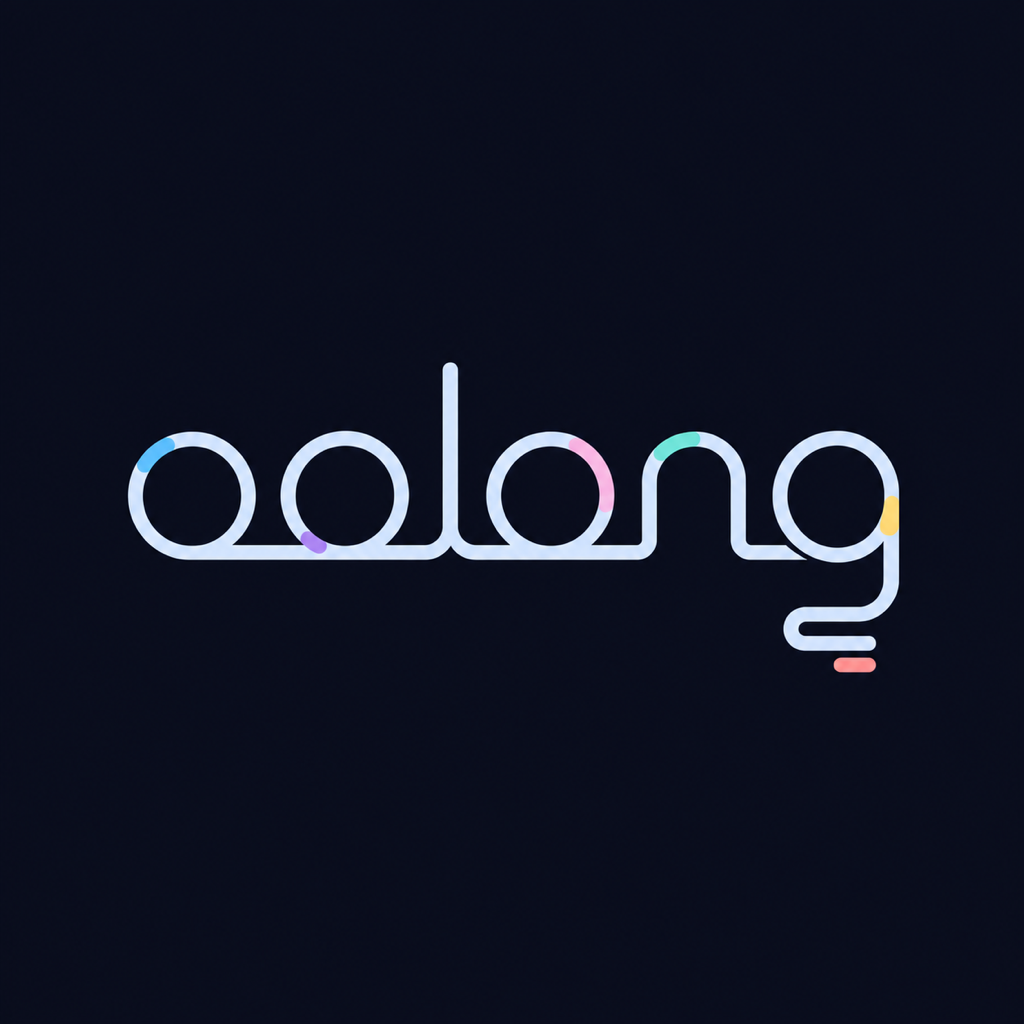
Oolong has two approved marks. Use the wordmark when the name has room to remain readable; use the compact icon for navigation, favicons, application launchers, and other small square surfaces.

6.1 Wordmark
The preferred wordmark is lowercase oolong. It should remain immediately readable at terminal-sized resolutions.
The most useful visual features are:
- rounded
oforms that suggest successive units in a flow; - a clear vertical
lthat can act as a processing or ownership boundary; - continuous left-to-right spacing rather than a sealed badge;
- an unmistakable
n, preserving the spelling; - a
gwhose descender may imply continuation into history.
The letter story should be discoverable, not diagrammed into the logo. Readability comes before cleverness.
6.2 Motion
If the brand is animated, motion should express the architecture:
- small units arrive from the left;
- they pass a narrow boundary;
- one live unit changes;
- settled units continue into a quiet history.
Motion should stop when the transition is complete. A permanently moving idle logo would contradict the product's quiet, event-driven character. Animation must also have a reduced-motion or static equivalent.
6.3 Color and contrast
A warm tea or amber accent can distinguish Oolong from cold terminal-tool palettes. Neutral ink, charcoal, cream, and terminal-native foreground/background values should carry most of the interface.
No meaning may depend on color alone. The wordmark and diagrams must work in monochrome, and component themes must preserve readable contrast in real terminal color depths. Exact palette values belong in a future visual asset specification, not in the architecture or core packages.
7. The metaphor boundary
The brand may use flow and tea imagery. The public Go API uses domain language.
Prefer names such as:
Stream,Decoder,Transcript,Commit,Frame,Runtime, andDispatcher;Editor,Dialog,List, and other names for the behavior users actually need.
Do not introduce names such as Brew, Steep, Cup, Leaf, or Infusion merely to match the product name. A metaphor that makes a user translate before understanding an operation is an abstraction leak.
The same rule applies to the visual letter story. oo, l, o, and ng do not become package names, protocol phases, or exported state constants. Brand meaning may explain the system; it does not direct lower layers with upper-level vocabulary.
8. Standard copy
Repository description
A streaming-first terminal UI substrate for Go.
Short introduction
Oolong builds terminal interfaces around the lifetime of output. Open content stays live and interactive; finished content flows into terminal scrollback, keeping long-running sessions incremental and bounded.
Component introduction
Compose complete headless behavior with polished, themeable components, then keep product-specific workflow in the application.
Supporting line
Streams can be long. The live interface stays bounded.
These lines may be shortened for layout, but their meaning should not be replaced by a generic claim such as "build beautiful TUIs". Appearance matters; the lifetime model is what makes Oolong distinct.
9. Brand review checklist
Before publishing a README, website, release page, example, logo, or talk:
- Is the name spelled
Oolongoroolong, neverooloog? - Does the first technical description say streaming-first and terminal UI for Go?
- Does "streaming" mean incremental lifetime and publication, not merely animated text?
- Is boundedness presented as a tested architecture property rather than a mood?
- Are headless behavior, polished
kitcomponents, and application grammar distinct? - Does the visual flow move left to right and settle when finished?
- Is the
nlegible, and does the mark work without color or motion? - Are performance and compatibility claims backed by the repository's actual gates?
- Have tea and letter metaphors stayed out of package and API naming?
- Does the copy sound calm and exact rather than inflated or defensive?